 EN
EN


What are compressed towel tablets and how do they expand with water?
If you have ever come across a small, coin-shaped pellet that transforms into a full-sized towel the moment it touches water, you have already encountered one of the most practical innovations in personal care and travel accessories. compressed towel tablets are compact, pre-formed pieces of tightly pressed fabric that expand dramatically when exposed to moisture. They have gained significant traction across travel, hospitality, outdoor recreation, and hygiene product markets because they solve a very real problem: how to carry a functional towel without sacrificing valuable space or adding unnecessary weight.
Understanding what compressed towel tablets are and how their expansion mechanism works is useful not only for consumers choosing travel accessories but also for businesses sourcing hygiene products, hospitality operators stocking amenities, and procurement teams evaluating sustainable alternatives to single-use paper towels. This article breaks down the composition, the science behind the expansion, the practical applications, and the key considerations that make compressed towel tablets a compelling product category in today's market.
What Compressed Towel Tablets Are Made Of
The Core Material: Fabric Selection and Fiber Composition
Compressed towel tablets are most commonly manufactured from natural cotton, non-woven fabric blends, or a combination of both. Pure cotton versions are highly absorbent, soft against the skin, and biodegradable, making them a preferred choice for premium personal care and eco-conscious product lines. Non-woven variants, often made from viscose or a cotton-viscose blend, offer a balance between softness, durability, and cost efficiency.
The fabric used in compressed towel tablets is typically cut to a specific size before compression. Depending on the intended end use, the uncompressed towel can range from a small facial wipe of roughly 20 x 20 centimeters to a larger body towel exceeding 70 x 30 centimeters. The final compressed size, however, is dramatically reduced — often to a disc or tablet no larger than a coin or a small candy.
Fiber quality directly affects the performance of compressed towel tablets after expansion. Higher-quality cotton fibers produce a softer, more absorbent towel that holds its shape well after repeated use. Lower-grade blends may feel rougher or lose structural integrity more quickly, which is an important consideration for buyers sourcing at scale for hospitality or retail distribution.
The Compression Process and Binding Agents
The manufacturing process behind compressed towel tablets involves mechanically pressing the fabric under high pressure to reduce its volume to a fraction of its original size. In many cases, a water-soluble binding agent or a light coating is applied to help the tablet maintain its compact shape during storage, shipping, and handling. This binding agent is specifically designed to dissolve instantly upon contact with water, which is what triggers the expansion.
Some compressed towel tablets use no chemical binding agents at all, relying purely on the mechanical compression and the natural cohesion of tightly packed fibers to hold their shape. These versions are particularly valued in markets where clean-label, chemical-free, or organic product positioning is important. The absence of additives also makes them more suitable for sensitive skin applications.
The shape of compressed towel tablets varies by manufacturer and intended use. Round disc shapes are the most common for facial and personal care applications, while rectangular or cylindrical tablet forms are often used for larger body towels. Regardless of shape, the compression ratio is a key quality indicator — a well-made compressed towel tablet should expand to its full usable size within seconds of water contact.
How Compressed Towel Tablets Expand with Water
The Physical Mechanism of Expansion
The expansion of compressed towel tablets is driven by a straightforward physical process. When the tablet is placed in water or water is poured over it, the moisture penetrates the tightly packed fiber structure. The water molecules interact with the compressed fibers, breaking the surface tension that holds them in their compacted state. As the fibers absorb water, they swell and begin to separate from one another, releasing the stored mechanical energy from the compression process.
This process happens rapidly. Most compressed towel tablets reach their full expanded size within 10 to 30 seconds when submerged in water. The speed of expansion depends on several factors, including the density of the compression, the fiber type, the water temperature, and whether a water-soluble binding agent is present. Warm water generally accelerates the expansion process compared to cold water, though most quality compressed towel tablets will expand fully in either condition.
Once fully expanded, the towel behaves exactly like a conventional fabric towel. It can be wrung out, used for wiping or drying, and in many cases washed and reused multiple times before disposal. This reusability is one of the features that distinguishes premium compressed towel tablets from single-use disposable wipes.
The Role of Water-Soluble Coatings in Controlled Expansion
For compressed towel tablets that use a water-soluble coating or binding agent, the expansion process involves an additional chemical step. The coating dissolves as water contacts the outer surface of the tablet, releasing the compressed fabric beneath. This dissolution typically happens within the first few seconds of water exposure, after which the physical fiber-swelling mechanism takes over.
Water-soluble coatings are formulated to be completely safe for skin contact and environmentally benign. They are designed to leave no residue on the expanded towel and to break down harmlessly in wastewater systems. For product developers and procurement teams, verifying the safety and biodegradability of any coating used in compressed towel tablets is an important due diligence step, particularly for products intended for sensitive skin or eco-certified product lines.
The controlled expansion enabled by these coatings also helps compressed towel tablets maintain their shape and integrity during long-term storage. A well-coated tablet can remain stable for months or even years in dry conditions, making compressed towel tablets an excellent option for emergency kits, travel packs, and long-shelf-life retail products.
Practical Applications of Compressed Towel Tablets
Travel and Personal Care Use Cases
The most widely recognized application for compressed towel tablets is in travel. Frequent travelers, backpackers, and outdoor enthusiasts value them because a single small pouch can carry dozens of towels that would otherwise take up significant luggage space. Airlines, hotels, and travel kit suppliers have incorporated compressed towel tablets into amenity packages as a lightweight, hygienic, and visually appealing alternative to bulky rolled towels or disposable paper products.
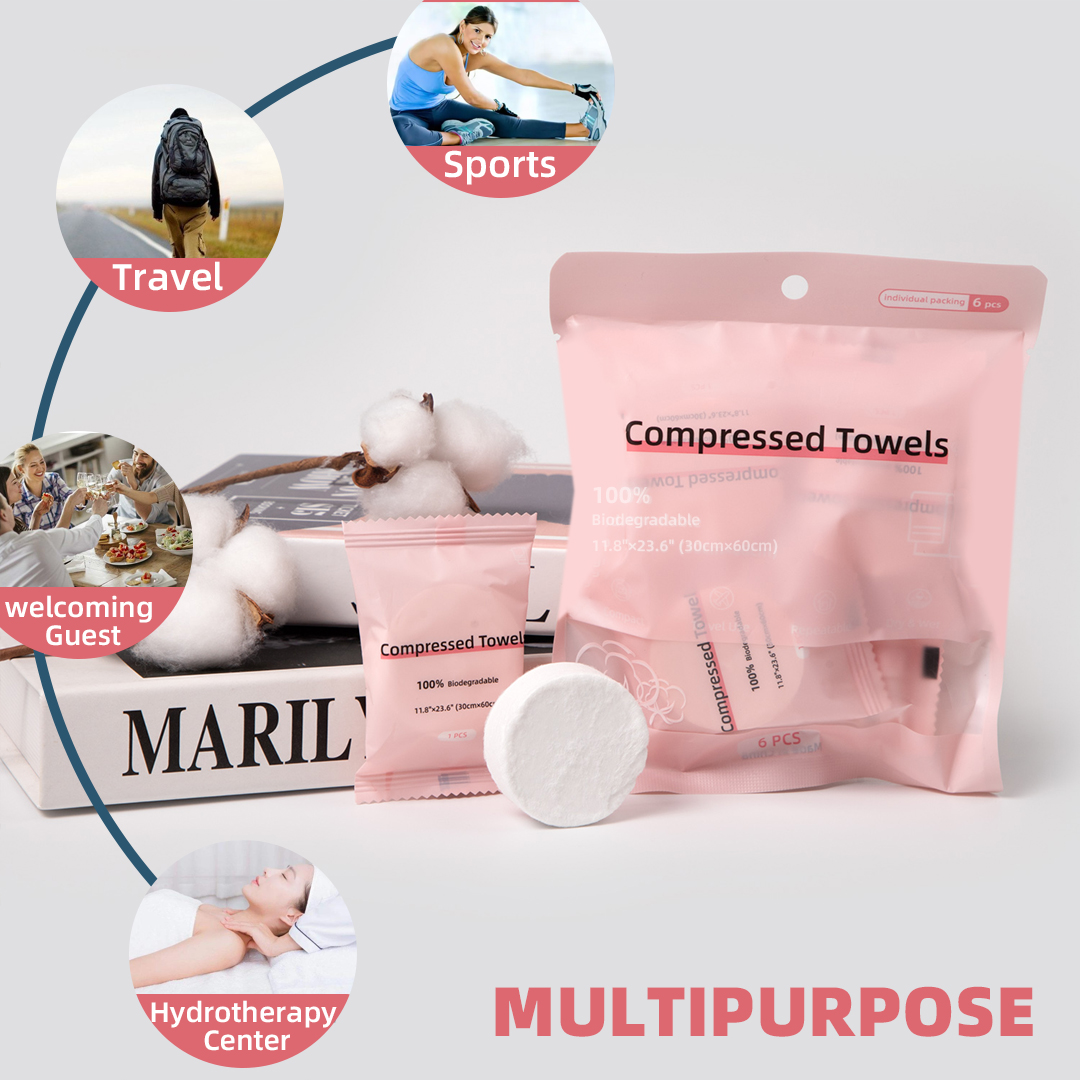
In personal care routines, compressed towel tablets are commonly used as facial cleansing cloths, makeup removal wipes, and post-workout towels. Their compact size makes them easy to store in gym bags, handbags, and desk drawers. Because many versions are made from soft cotton, they are gentle enough for daily facial use, including for individuals with sensitive or acne-prone skin.
The hygiene benefits of compressed towel tablets are also relevant in healthcare and clinical settings. Single-use compressed towel tablets offer a sterile, individually packaged option for patient care, wound cleaning, and post-procedure hygiene. Their sealed packaging ensures they remain uncontaminated until the moment of use, which is a meaningful advantage over pre-moistened wipes that may contain preservatives or other additives.
Hospitality, Retail, and B2B Sourcing Contexts
For hospitality operators, compressed towel tablets present an opportunity to reduce linen costs, simplify logistics, and offer guests a novel, memorable amenity experience. Boutique hotels, spas, and wellness centers have adopted them as part of their in-room or treatment room setups. The compact packaging also reduces storage space requirements and simplifies inventory management compared to traditional towel stocking.
In retail, compressed towel tablets are sold as standalone products, as part of travel kits, and as branded promotional items. Their visual appeal — a small, neatly packaged tablet that dramatically transforms with water — makes them effective for in-store demonstrations and social media marketing. Brands in the beauty, wellness, and outdoor categories have found compressed towel tablets to be a strong product line addition that aligns with consumer interest in minimalism and sustainability.
B2B buyers sourcing compressed towel tablets at volume should evaluate suppliers on several criteria: fiber quality and softness, compression ratio and expansion reliability, packaging options, minimum order quantities, and certifications relevant to their target market. For products destined for personal care or healthcare use, certifications such as OEKO-TEX Standard 100 or equivalent safety standards provide important assurance of material safety.
Sustainability and Environmental Considerations
Why Compressed Towel Tablets Support Eco-Friendly Goals
One of the strongest arguments for compressed towel tablets in both consumer and B2B contexts is their environmental profile. Because they are made primarily from natural cotton or biodegradable non-woven materials, they decompose far more readily than synthetic disposable wipes. Many compressed towel tablets are also designed for multiple uses, which reduces the per-use environmental impact compared to single-use alternatives.
The compact size of compressed towel tablets also has indirect environmental benefits. Smaller product volume means more units can be shipped per container, reducing transportation emissions per unit. Lighter packaging reduces material waste. For brands and retailers with sustainability commitments, these logistical advantages can contribute meaningfully to carbon footprint reduction targets.
Compressed towel tablets made from organic cotton or certified sustainable fibers carry an additional environmental credential. As consumer demand for transparent, responsibly sourced personal care products continues to grow, the ability to offer compressed towel tablets with verified sustainability credentials becomes a competitive differentiator for brands operating in premium or eco-conscious market segments.
Comparing Compressed Towel Tablets to Conventional Alternatives
When compared to conventional rolled towels, compressed towel tablets offer clear advantages in portability, storage efficiency, and hygiene assurance through individual packaging. They do not require laundering infrastructure at the point of use, which is a practical benefit in travel, outdoor, and emergency contexts. However, for everyday home use where laundering is convenient, traditional towels remain cost-effective over the long term.
Against pre-moistened disposable wipes, compressed towel tablets have the advantage of being dry until activated, which eliminates the need for preservatives in the product itself. This makes them a cleaner formulation option and extends shelf life without chemical intervention. For buyers concerned about ingredient transparency or regulatory compliance in personal care products, this is a meaningful distinction.
The decision to source compressed towel tablets over conventional alternatives ultimately depends on the specific use case, the target consumer profile, and the operational context. For applications where portability, hygiene, and sustainability are prioritized, compressed towel tablets consistently offer a strong value proposition that justifies their place in a product lineup.
FAQ
How long does it take for compressed towel tablets to fully expand?
Most compressed towel tablets expand to their full size within 10 to 30 seconds when placed in water or when water is poured directly over them. Warm water tends to speed up the process slightly, but quality compressed towel tablets will expand fully in cold water as well. The exact time depends on the compression density, fiber type, and whether a water-soluble coating is used.
Can compressed towel tablets be reused after the first expansion?
Yes, most compressed towel tablets can be rinsed, wrung out, and reused multiple times after their initial expansion, provided they are made from durable fabric such as cotton or a cotton-viscose blend. After use, they should be allowed to dry fully before storage to prevent mildew. The number of reuse cycles depends on the fiber quality and how the towel is handled between uses.
Are compressed towel tablets safe for sensitive skin?
Compressed towel tablets made from pure cotton or certified organic cotton are generally well-suited for sensitive skin. Products that use no chemical binding agents or that carry skin safety certifications such as OEKO-TEX Standard 100 provide additional assurance. Buyers sourcing for sensitive skin applications should verify the material composition and any certifications with their supplier before committing to a product line.
What sizes do compressed towel tablets come in after expansion?
Compressed towel tablets are available in a range of expanded sizes depending on their intended use. Facial and personal care versions typically expand to approximately 20 x 20 centimeters, while larger body towel versions can expand to 70 x 30 centimeters or more. The compressed tablet itself is usually no larger than a coin or small disc regardless of the final expanded size, which is what makes compressed towel tablets so effective for space-saving applications.

