 EN
EN


What role do perforations play in single-use cotton tissue design?
When you pull a sheet from a roll or pack of single-use cotton tissues, the ease with which it separates cleanly and consistently is rarely accidental. That precision is the result of deliberate engineering, and at the center of that engineering sits one deceptively simple feature: the perforation. In the world of perforated cotton facial tissues, the pattern, depth, and spacing of those tiny cuts determine everything from how the product feels in your hand to how reliably it performs during a skincare routine.
Understanding the role of perforations goes well beyond surface-level product knowledge. For brand developers, procurement specialists, and private-label buyers, grasping how perforation design influences structural integrity, dispensing behavior, and end-user satisfaction is essential to making informed sourcing decisions. This article examines the functional logic behind perforations in single-use cotton tissue design, explaining why this feature is far more than a convenience detail.
The Functional Purpose of Perforations in Cotton Tissue Design
Controlled Separation Without Structural Compromise
The primary role of perforations in perforated cotton facial tissues is to create a controlled tear line that allows users to separate individual sheets cleanly and with minimal effort. Without perforations, a continuous roll or folded stack of cotton tissue would require cutting tools or result in ragged, uneven edges that compromise both aesthetics and usability. The perforation line acts as a pre-engineered weak point that guides the tear precisely where the designer intended.
What makes this engineering challenge interesting is that the perforation must be strong enough to survive handling, packaging, and dispensing, yet weak enough to yield cleanly under light manual tension. Achieving this balance requires careful calibration of the cut-to-land ratio, which refers to the proportion of material removed versus material retained along the perforation line. Too many cuts and the sheet tears prematurely during dispensing. Too few and the user struggles to separate sheets, leading to frustration and product waste.
In perforated cotton facial tissues specifically, this balance is more nuanced than in paper-based products because cotton fibers behave differently under tension. Cotton has a natural elasticity and fiber entanglement that paper lacks, meaning the perforation geometry must account for how the material stretches before it tears. Designers working with cotton substrates typically use shorter cut lengths and tighter spacing than they would for paper, ensuring the tear initiates and propagates cleanly along the intended line.
Maintaining Sheet Integrity Before Use
A well-designed perforation does not weaken the sheet during normal use — it only activates under deliberate separation force. This distinction is critical for perforated cotton facial tissues used in skincare applications, where the sheet must withstand saturation with toner, micellar water, or cleansing solution without splitting along the perforation line mid-use. The structural integrity of the sheet during application depends on the perforation being directionally specific, meaning it yields under pulling tension perpendicular to the line but resists forces applied parallel to it or distributed across the sheet surface.
This directional resistance is achieved through the geometry of individual perforation cuts. Elongated cuts oriented perpendicular to the tear direction create a weaker line in that axis while preserving lateral strength. Manufacturers of perforated cotton facial tissues invest significant development effort into optimizing this geometry so that the product holds together during use but separates effortlessly when the user intends it to.
How Perforation Design Affects Dispensing and User Experience
Roll Format and Dispensing Consistency
For perforated cotton facial tissues supplied in roll format, the perforation spacing directly determines sheet size and dispensing consistency. Each perforation line marks the boundary of one usable sheet, so the distance between lines defines how much material the user receives per pull. Inconsistent spacing leads to variable sheet sizes, which frustrates users who expect a standardized amount of product per use. In professional or clinical settings, this inconsistency can also affect protocol compliance, where a defined amount of cotton tissue is required per application step.
Dispensing consistency also depends on how cleanly the perforation releases under the specific dispensing mechanism being used. Wall-mounted dispensers, countertop holders, and freestanding rolls all apply different force vectors to the tissue during separation. Perforated cotton facial tissues designed for a specific dispenser type are typically engineered with perforation parameters tuned to that dispenser's pull angle and resistance profile. A perforation optimized for hand-pull dispensing may not perform as cleanly in a mechanical dispenser, and vice versa.
Tactile Feedback and Perceived Quality
The sensory experience of separating a sheet from a roll or pack of perforated cotton facial tissues contributes meaningfully to perceived product quality. A clean, satisfying tear with minimal resistance signals to the user that the product is well-made and reliable. A ragged tear, a sheet that requires excessive force, or one that splits unpredictably creates a negative impression that can undermine brand perception regardless of the underlying cotton quality.
This tactile dimension is why perforation design is treated as a brand-relevant engineering decision rather than a purely functional one. Premium perforated cotton facial tissues often feature tighter perforation tolerances and more refined cut geometries that produce a noticeably cleaner separation experience. This difference is immediately apparent to end users even if they cannot articulate the technical reason behind it, and it directly influences repurchase behavior and brand loyalty.
The edge quality of the separated sheet also matters. A clean perforation line leaves a smooth, even edge that feels refined against the skin. A poorly executed perforation leaves micro-tears and fiber fraying along the edge, which can feel rough and may shed lint onto the face during use. For perforated cotton facial tissues marketed as lint-free or dermatologist-tested, edge quality is a non-negotiable performance criterion tied directly to perforation precision.
Perforation Patterns and Their Influence on Cotton Tissue Performance
Straight Versus Micro-Perforations
Not all perforations are created equal, and the pattern type chosen for perforated cotton facial tissues has measurable consequences for both performance and manufacturing cost. Straight perforations, where cuts are aligned in a single linear row across the sheet width, are the most common and cost-effective option. They are straightforward to produce on standard converting equipment and deliver reliable separation performance for most consumer applications.
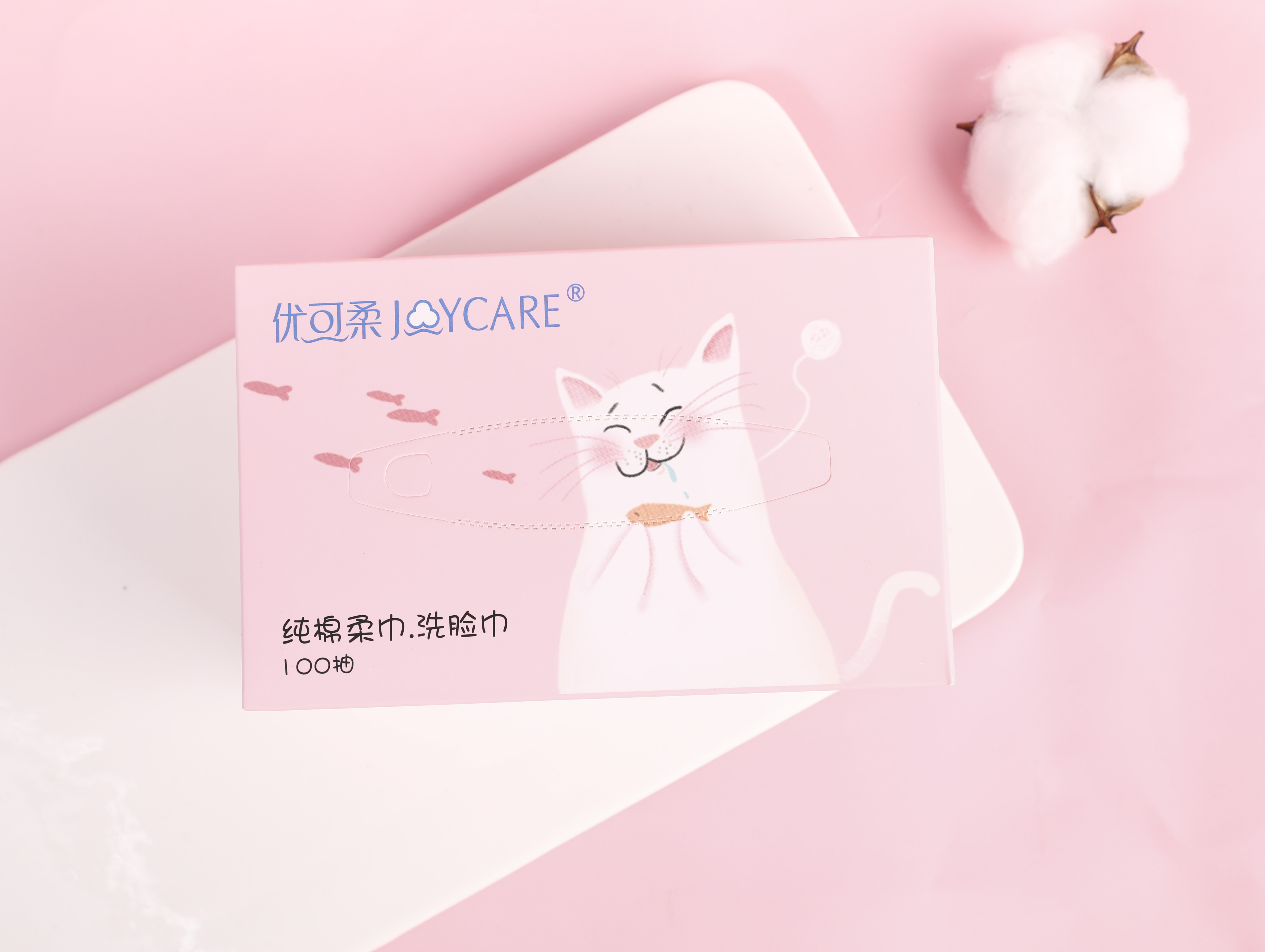
Micro-perforations use much smaller individual cuts spaced more closely together, creating a denser line of weakness that tears with exceptional smoothness. The resulting edge is nearly indistinguishable from a cut edge, which is why micro-perforations are favored in premium perforated cotton facial tissues where edge refinement is a key differentiator. The trade-off is higher tooling cost and more demanding quality control requirements, since the smaller cuts are more sensitive to substrate thickness variation and fiber density inconsistencies.
Perforation Orientation and Multi-Directional Designs
Standard perforations run perpendicular to the machine direction, creating horizontal tear lines across the width of the tissue. This orientation works well for roll formats where the user pulls downward or outward to separate sheets. However, some formats of perforated cotton facial tissues use alternative orientations or multi-directional perforation grids that allow the sheet to be divided in more than one direction, giving users flexibility to use a half-sheet for lighter tasks and a full sheet for more intensive applications.
Multi-directional perforation designs are more complex to engineer and manufacture, but they add genuine functional value in contexts where material conservation is a priority. For brands positioning their perforated cotton facial tissues around sustainability or cost-efficiency messaging, the ability to use partial sheets without waste is a compelling product feature that the perforation design directly enables.
Manufacturing Considerations for Perforation Quality
Tooling Precision and Substrate Compatibility
The quality of perforations in perforated cotton facial tissues is ultimately a function of tooling precision and substrate compatibility. Perforation is typically applied during the converting stage using rotary die-cutting equipment fitted with perforation blades. The blade geometry, including tooth height, tooth spacing, and blade angle, must be matched to the specific cotton substrate being processed. A blade configuration optimized for a dense, tightly woven cotton fabric will produce poor results on a loosely structured spunlace nonwoven, and vice versa.
Substrate thickness uniformity is equally important. Cotton-based materials can exhibit natural variation in fiber density and thickness across a roll, and these variations affect how consistently the perforation blade penetrates the material. Manufacturers of high-quality perforated cotton facial tissues invest in substrate quality control upstream of the converting process to minimize this variation and ensure that perforation depth remains consistent across the entire production run.
Quality Control and Defect Detection
Perforation quality control in the production of perforated cotton facial tissues typically involves both in-line monitoring and offline testing. In-line vision systems can detect missing perforations, misaligned lines, or incomplete cuts in real time, allowing the production line to flag or reject defective sections before they reach the finished product stage. Offline testing involves applying standardized separation force to sample sheets and measuring the force required to initiate and complete the tear, comparing results against specification limits.
Defects in perforation quality are not always visible to the naked eye but can have significant downstream consequences. A perforation line with insufficient cut depth may appear normal but will require excessive force to separate, leading to user complaints. A line with too much cut depth may cause premature separation during packaging or dispensing, resulting in product damage and waste. Rigorous quality control at the perforation stage is therefore a critical component of delivering consistent, reliable perforated cotton facial tissues to market.
Perforations as a Design Signal for Brand Positioning
Communicating Quality Through Functional Detail
In the competitive landscape of single-use skincare products, perforations serve as a subtle but effective signal of product quality and brand attention to detail. Consumers who regularly use perforated cotton facial tissues develop an intuitive sense of what a well-made product feels like, even if they cannot describe the engineering behind it. A product that tears cleanly, holds together during use, and leaves a smooth edge communicates craftsmanship without requiring any marketing language to make the point.
For private-label brands and OEM buyers, this means that perforation specification is a brand decision as much as a technical one. Choosing a tighter micro-perforation pattern for a premium product line versus a standard straight perforation for a value line is a deliberate positioning choice that shapes how the end user experiences and perceives the brand. Perforated cotton facial tissues that consistently deliver a refined separation experience build the kind of quiet brand trust that drives long-term customer retention.
Alignment with Sustainability and Minimalism Trends
Perforation design also intersects with broader sustainability trends in the single-use personal care category. Products that allow users to use partial sheets through multi-directional perforations, or that use minimal packaging enabled by reliable roll-format dispensing, align with consumer preferences for reduced waste. Perforated cotton facial tissues that are engineered to dispense one sheet at a time without over-dispensing contribute to a more controlled and less wasteful user experience, which is increasingly a purchase driver in environmentally conscious market segments.
Brands that communicate the functional logic of their perforation design — explaining how it enables precise dosing, reduces waste, or improves hygiene — can differentiate their perforated cotton facial tissues in a category where many products appear superficially similar. The perforation, often overlooked as a minor manufacturing detail, becomes a storytelling asset when its functional benefits are clearly articulated to the target audience.
FAQ
Why do some perforated cotton facial tissues tear unevenly?
Uneven tearing in perforated cotton facial tissues is usually caused by inconsistent perforation depth, substrate thickness variation, or a mismatch between the perforation blade geometry and the cotton material being processed. It can also result from improper storage conditions that cause the cotton to absorb moisture and change its tensile properties, making the perforation line behave differently than it would under normal conditions.
Does the perforation pattern affect how lint-free a cotton tissue is?
Yes, the perforation pattern has a direct influence on edge fiber behavior. Micro-perforations produce a cleaner, more refined edge with less fiber fraying compared to standard straight perforations. For perforated cotton facial tissues marketed as lint-free, micro-perforation or high-precision straight perforation is typically specified to minimize loose fibers along the separated edge.
Can perforation design be customized for private-label products?
Perforation parameters including cut length, spacing, orientation, and pattern type can generally be customized during the product development stage for private-label perforated cotton facial tissues. Customization options depend on the manufacturer's converting equipment capabilities and minimum order requirements. Buyers seeking differentiated perforation performance should discuss tooling specifications and substrate compatibility with their supplier early in the development process.
How does perforation spacing relate to sheet size in roll-format tissues?
In roll-format perforated cotton facial tissues, the distance between consecutive perforation lines directly determines the sheet size. Closer spacing produces smaller sheets, while wider spacing produces larger ones. Sheet size is a key specification that affects both user experience and material cost per use, and it is typically defined during product development based on the intended application and target price point.

